If you have been asked to report your carbon emissions, by a customer, a bank, or a regulator, you have almost certainly come across the terms Scope 1, Scope 2, and Scope 3. These three categories form the foundation of almost every carbon reporting framework in use today, including the UAE’s own requirements under Federal Decree-Law No. 11 of 2024.
Here is what they mean in plain language, with UAE-relevant examples for each.
The GHG Protocol – where the categories come from
Scope 1, 2, and 3 are defined by the Greenhouse Gas (GHG) Protocol, the international standard used by most governments, businesses, and rating agencies worldwide, including EcoVadis and the frameworks referenced under UAE Decree-Law No. 11 of 2024. If you are reporting emissions in the UAE, you are almost certainly using GHG Protocol methodology, whether you know it or not.
Scope 1: your direct emissions
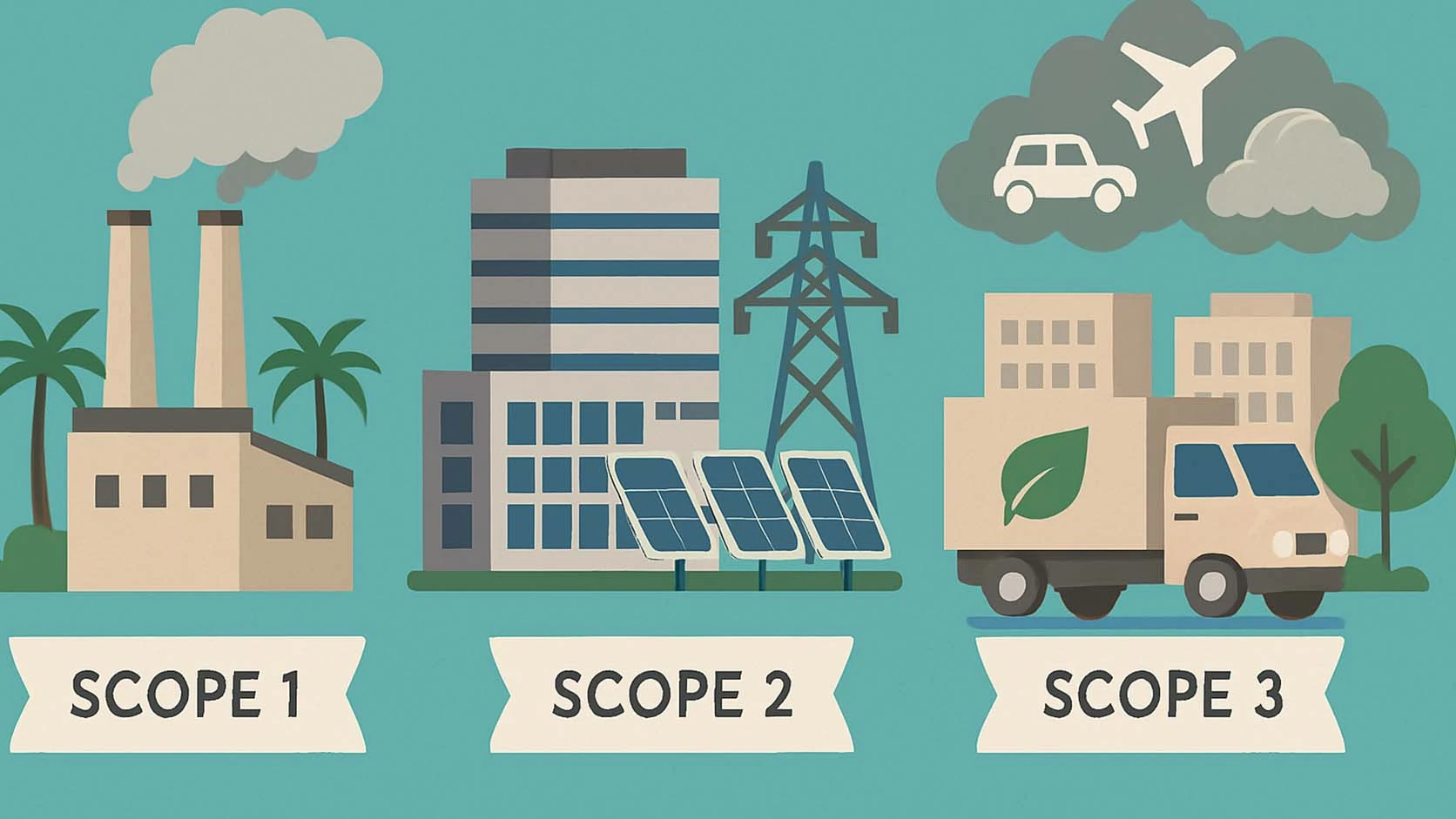
Scope 1 covers emissions from sources that your business owns or directly controls. Think of it as the fuel your business burns and the gases it releases itself.
For a typical UAE SME, Scope 1 emissions can come from –
- Diesel or petrol burned in company-owned or leased vehicles
- Diesel used in on-site generators which is common across UAE construction sites, warehouses, and facilities that supplement grid power
- Gas appliances such as commercial kitchens, boilers, or heating systems
- Refrigerant leaks from air conditioning systems, particularly relevant in the UAE given the scale of AC use in commercial premises
Scope 1 is typically the easiest category to start with because the data (fuel receipts, vehicle logs, generator records etc.) is usually already being tracked for operational or financial reasons.
Scope 2: your electricity emissions
Scope 2 covers emissions from the electricity, heat, or steam that your business purchases from an external provider. You are not producing these emissions directly, but you are responsible for them because your demand drives their production.
For UAE businesses, Scope 2 is almost entirely about electricity consumption. The UAE grid is powered by a mix of natural gas, nuclear, and renewable sources, and the carbon intensity of that grid varies by emirate. DEWA (Dubai), ADDC (Abu Dhabi), and SEWA (Sharjah) each have different emission factors, which is why your emirate matters when calculating Scope 2.
The data you need is straightforward: your electricity bills for the past 12 months. The number on the bill in kilowatt-hours (kWh) is your activity data.
Scope 3: Your value chain emissions
Scope 3 is the broadest and most complex category. It covers all other indirect emissions connected to your business. Everything upstream and downstream that you do not directly control but that your business activity influences.
Scope 3 can include:
- Business travel such as flights, hotel stays, taxis taken by employees
- Employee commuting
- Goods and materials you purchase and the emissions involved in producing them
- Waste generated by your operations and sent to landfill or treatment
- The use and disposal of products you sell
For most UAE SMEs, Scope 3 is not yet legally required under Decree-Law No. 11 of 2024, though this is expected to change. However, customers, especially large multinationals managing their own Scope 3 may already be asking for it. If a customer asks for your carbon footprint, they are often asking for Scope 1 and 2 as a minimum, with Scope 3 becoming more common.
Where to Start
The practical starting point for any UAE business is Scopes 1 and 2. These are measurable, the data is accessible, and they form the required foundation for regulatory reporting under Decree-Law No. 11 of 2024. Once Scopes 1 and 2 are established and documented, Scope 3 can be built out progressively.
If you are unsure where your emissions sit or how to get started, Kaynat Advisory helps UAE SMEs calculate their carbon footprint and produce reports that meet both customer and regulatory requirements. Contact us at info@kaynatadvisory.com or call +971 50 907 8152.